The Pinery Is About to Break Out
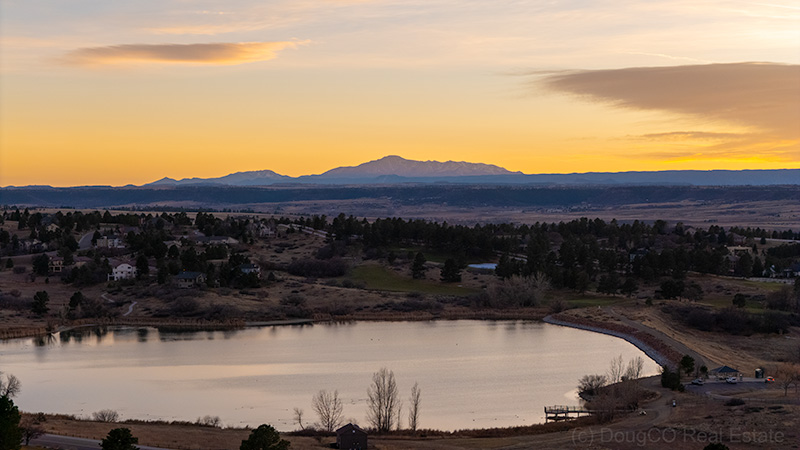
For decades, "out there" has been the quiet knock on The Pinery. Parker and Castle Rock have now erased that gap — and a flagship King Soopers is arriving in Q4 2026. The window of undervaluation may be shorter than most homeowners realize.
Ask any longtime Douglas County real estate agent about The Pinery and you'll get some version of the same answer: "Beautiful neighborhood. Great homes. Just... out there."
That "out there" has been a pricing discount for twenty years. Homes in The Pinery — custom builds on large lots with mature Ponderosa pines and mountain views — have sold at a meaningful discount to Castle Pines Village and other prestige addresses in the county. Not because the homes are inferior. Because the location felt remote.
That perception is now colliding with reality. And the data suggests the collision is going to be expensive for anyone who waits too long to pay attention.
The Geography Has Changed
The Pinery sits along Highway 83 (South Parker Road), roughly between Parker to the north and Castle Rock to the west. For years, undeveloped land buffered it from both. That buffer is effectively gone.
Parker has extended through Reata South and Pradera, pushing its footprint to the edges of Pinery infrastructure. Castle Rock has expanded its municipal limits to the South Parker Road corridor — literally across the street from The Pinery entrance. The community that was once described as "a 20-minute drive from anything" now sits at the intersection of three of the fastest-growing economic zones in Douglas County.
The Douglas County 2040 Comprehensive Master Plan directs urban growth toward the northern corridor and municipalities. As those areas approach planned density, The Pinery — with mature infrastructure, large lots, and established housing stock — transitions from a peripheral enclave to an urban infill zone.
The commute argument, once used against The Pinery, has quietly reversed. Residents can reach the Denver Tech Center in 20–25 minutes via Parker Road or E-470. Residents of southern Castle Rock — some of whom pay a $1M+ premium for their address — face the same commute or longer. The "accessibility discount" is becoming an accessibility premium.
The Commercial Catalyst Arriving in 2026
If there is one single event that will mark the before-and-after for Pinery valuations, it is the Pinery Marketplace — a 121-acre commercial development at the corner of North Pinery Parkway and South Parker Road.
The centerpiece is a flagship Super King Soopers scheduled for Q4 2026. This is not a detail. Kroger does not commit to a flagship-format store without exhaustive trade area analysis. The company requires a specific threshold of affluent household density before it builds at this scale. Their decision to place a flagship here is, functionally, a high-conviction institutional endorsement of the Pinery trade area.
For decades, Pinery residents have driven into central Parker or Castle Rock for groceries. That structural deficit — which has historically served as a cap on price appreciation — is being corrected at scale.
| Planning Area | Designation | Acres | Primary Uses |
|---|---|---|---|
| PA 40-A | Town Center | 29.3 | Flagship King Soopers, retail shops, dining |
| PA 38 | Business Park | 29.7 | Medical office, flexible tech, light industrial |
| PA 41 | Business Park | 35.5 | Institutional, large-format office |
| PA 42 | Business Park | 11.7 | Hotel, professional services |
| PA 43 | Mixed-Use | 15.0 | RTD Park & Ride, mixed-use |
The inclusion of an RTD Park & Ride in the master plan is notable — it signals that regional planners are integrating The Pinery into the broader transit network, not treating it as a cul-de-sac community. Nearly 100 acres of business park and office space will attract employers, tightening the local housing market as professionals seek proximity to work.
The Subdivisions: What You're Actually Buying
The Pinery is not a single neighborhood. It is a collection of distinct communities, each with its own character, price tier, and appreciation trajectory. Understanding the taxonomy matters if you're evaluating what's actually undervalued.
The Original Pinery (managed by PHA, ~1,800 homes)
The core community is characterized by individuality — very few repeated floor plans exist, because the original 1970s and '80s development was built around custom and semi-custom architecture adapted to sloped terrain. As of Q1 2026, the median sale price is $885,000 with a price-per-square-foot of $252. Days on market: 20.
Compare that to Castle Pines Village at $324/sqft with 135 days on market. The Pinery moves faster and sells cheaper — for homes that often feature superior lot sizes and equivalent finish levels. That's the gap.
High Prairie Farms: The Luxury Benchmark
HPF is the premier tier within the Pinery ecosystem. Lot sizes run 2.5 to 5 acres. Custom estates built by regional names like Celebrity Custom Homes, Wall Custom Homes, and Timber Ridge Properties. Multi-generational suites, home theaters, gourmet kitchens. Equestrian-friendly parcels.
| Metric | High Prairie Farms | What It Means |
|---|---|---|
| Lot sizes | 2.5–5.0 acres | Equestrian-friendly; increasingly rare at this price |
| Average sale price | $1,489,000 | Custom builds of 3,500–8,000+ sq ft |
| Highest recent sale | $2,142,130 | The high-end ceiling is rising |
| Price per sq ft | ~$250–$270 | Significant discount to Castle Pines luxury tier |
A custom home in High Prairie Farms with 6,000 sq ft and high-end finishes: $1.3M–$1.5M. A home of similar size, age, and finish in Castle Pines Village: $2.5M or higher. The gap is driven by perception, not physical utility.
High Prairie Farms at The Lake
A specialized enclave within HPF, with 1 to 1.67-acre lots oriented toward Bingham Lake. Water views, mountain views, and walk-out basements that frame both. A 5,384 sq ft home on a 0.93-acre lot recently sold for $1.44M — illustrating the demand for right-sized luxury that doesn't require managing a 5-acre estate.
Addresses on Prairie Lake Trail and Autumn Brush Court are the ones to watch. These homes sell quickly and represent some of the most distinctive real estate in the county — Spanish tile roofs, stucco exteriors, Rocky Mountain front range views. At current prices, they remain undervalued relative to comparable water-adjacent luxury in Parker or Castle Rock.
The Timbers at The Pinery
The modern evolution of the Pinery aesthetic. Homes built post-1990 through the 2000s, integrated into dense Ponderosa pine groves. The "private forest" atmosphere that has made this sub-neighborhood particularly resistant to the kind of cyclical softening that affects developments with no natural differentiation.
2025 average sale price: $1,505,844. Average price per square foot: $252.55. Long-term data from 2016–2025 shows steady appreciation with a sharp acceleration beginning in 2021 — a structural trend, not a pandemic blip. The Timbers benefits from a permanent competitive moat: you cannot build another Timbers. There is no more land with equivalent tree cover and lot sizes at this proximity to Denver.
The Arbitrage Thesis
Here's the comparison that makes real estate observers pay attention.
| Market Segment | Median Sale Price (Q1 2026) | Median Days on Market | Price/Sq Ft |
|---|---|---|---|
| The Pinery | $885,000 | 20 | $252 |
| Castle Rock (citywide) | $630,000 | 58 | $220–$240 |
| Parker (citywide) | $700,000 | 29 | ~$238 |
| Castle Pines Village | $1,835,000 | 135 | $324 |
| Pinery West / Luxury tier | $1,700,000 | 30–60 | ~$260–$280 |
The Pinery sits in a rare position: it offers a genuine luxury experience — large lots, custom builds, mature trees, community amenities — that significantly outperforms the citywide medians of Parker and Castle Rock. Yet it trades at a fraction of Castle Pines Village for homes that are, by many objective measures, equivalent or superior in lot size and architectural quality.
The delta is driven by prestige perception, not asset fundamentals. National pricing algorithms make this gap worse — they treat The Pinery and Castle Pines Village as part of the same market. As the "out there" perception erodes — and it is eroding — the gap narrows. Even a partial correction toward Castle Pines Village pricing would represent a 20–30% appreciation event independent of broader market conditions.
What Makes This Community Defensible
Not all appreciation theses play out. The Pinery's case is stronger than most because its value drivers are structural, not speculative.
Bingham Lake and Open Space
The social and environmental centerpiece of the community. Managed by a volunteer homeowner group since the mid-1980s. Stocked with largemouth bass and Kamloops rainbow trout. Protected by deeded perpetual use for all Pinery residents. Adjacent to an 11.5-acre parcel restricted to open space in perpetuity. You cannot develop around this lake. It is a fixed asset.
The Ponderosa Canopy
The mature Ponderosa Pines defining the neighborhood aesthetic are 170–180 years old — the trees deemed too young for harvest during the 1860s timber operations that supplied lumber to the early settlement of Denver. These trees cannot be replicated in any timeline relevant to a real estate investment horizon. They are irreplaceable and they create the "mountain feel" that drives premium demand.
The Pinery Country Club
Golf, tennis, swimming, clubhouse events — integrated into the community rather than adjacent to it. Combined with equestrian trails throughout High Prairie Farms, this creates resort-style living within 15 minutes of Parker Adventist Hospital, DTC, and the E-470 interchange.
Douglas County School District Feeder Pattern
Northeast Elementary → Sagewood Middle (16:1 student-teacher ratio) → Ponderosa High (~93% graduation rate). The DCSD system is largely neighborhood-based, offering Pinery residents a predictable K–12 path — a key driver of the community's exceptionally high owner-occupancy rate, which exceeds 99% in some HPF sub-neighborhoods.
Firewise Status and Infrastructure
In a market where wildfire insurance costs are increasingly affecting buyer decisions, The Pinery's managed approach to forest health is a direct financial asset. The High Prairie Farms Metropolitan District and Pinery HOA have implemented systematic fuel-reduction programs in collaboration with South Metro Fire Station #3, which operates within the community. Unlike rural acreage alternatives, The Pinery also sits on public water and wastewater infrastructure — eliminating the well and septic maintenance burden that erodes value in comparable rural properties.
The Historical Foundation That Explains the Trees
The "pineries" along Cherry Creek were among the first industrial resources extracted by Colorado settlers. When gold was discovered at Russellville in 1858 — frequently called the "Birthplace of Colorado" — a rush of prospectors came through on the Smoky Hill and Cherokee Trails. As they pushed west toward the mountains, the demand for timber to build Denver City and Auraria led to the systematic harvest of the vast Ponderosa forests along Cherry Creek.
The trees that form the canopy of today's Pinery neighborhood are the ones that were too young to harvest in the 1860s. They are now 170 to 180 years old. That is what you are buying when you buy in The Pinery — not landscaping, but living history. And it is impossible to reproduce.
The Three-Phase Outlook
Phase 1 — Commercial Validation (2026–2027): As the Pinery Marketplace goes vertical and the King Soopers opens, the "remote" narrative collapses. The $885,000 median becomes the floor, not the midpoint. Few homes remain below $1M.
Phase 2 — Luxury Arbitrage Correction (2027–2029): As Parker and Castle Rock approach density limits, the scarcity of 2-to-5-acre lots within 25 minutes of the DTC drives a premium for HPF and The Timbers. The $1M+ gap between Pinery and Castle Pines luxury estates begins to close.
Phase 3 — Regional Hub Maturity (2030+): The Pinery Marketplace matures into a full economic node — potentially including the RTD Park & Ride, medical services, and professional office space. The Pinery transitions from "a neighborhood of Parker" into a distinct, high-end community that serves as the gateway between suburban convenience and the Palmer Divide.
The time to acquire assets in the Pinery is in the pre-delivery phase of the Marketplace — before the King Soopers opens its doors and the "remote" discount officially expires. That window closes in Q4 2026.
What This Means If You Already Own Here
If you own a home in The Pinery, High Prairie Farms, or The Timbers, this analysis has a direct financial implication: your county assessment is almost certainly lagging behind where the market is heading.
Douglas County's 2025 assessments were calculated using sales data from a period that predates the Marketplace announcement and the full recognition of the urban convergence story. That means many Pinery homeowners are currently assessed at values that don't reflect current market realities — and are paying taxes accordingly.
The appeal window opens May 1, 2026. If your assessed value looks wrong in either direction, that's the time to act.
Know What Your Pinery Home Is Actually Worth
Market value report using 9+ comparable sales from the same database the Douglas County Assessor uses. Delivered in minutes.
Get Your Market Value Report →